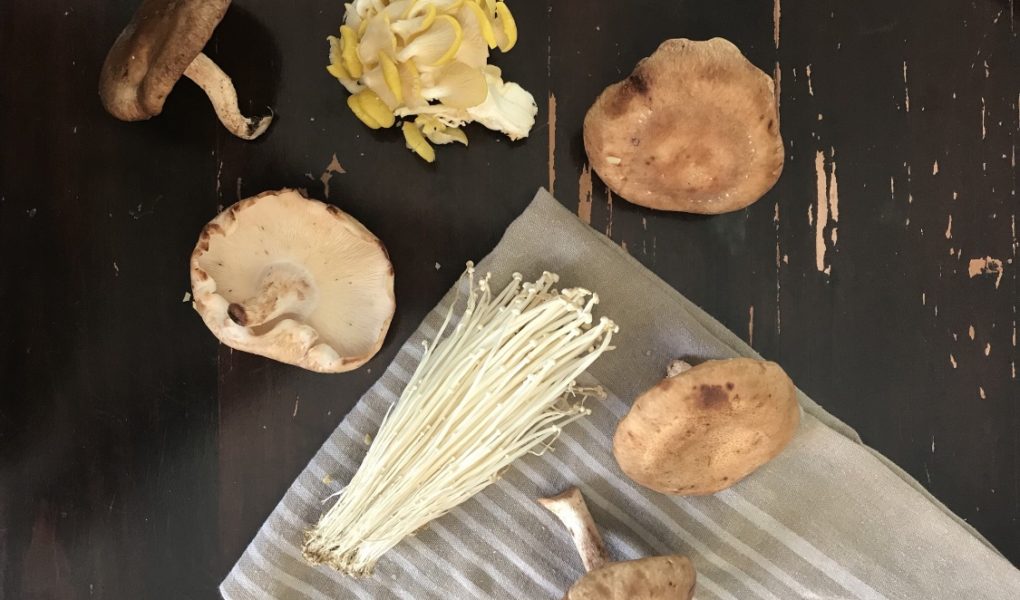
Mushrooms have been used for medicinal purposes since ancient times, from Europe to Asia. Sadly, our modern western diet is mostly devoid of them, at best appearing as an occasional pizza topping of at most 1-2 sliced mushrooms per pie for many consumers. While US Americans consume less than 4 pounds of mushrooms per year, the worldwide average is about 11 pounds per year [1]. They are ubiquitous in Japanese cuisine – just think of the famous shitake or maitake mushrooms. Japanese also have the longest life expectancy of all peoples today. Maybe this is not by coincidence.
Key nutritional ingredients in all mushrooms, in varying amounts, are selenium, B-Vitamins, Vitamin D, fiber, ergothioneine, and glutathione [2]. In fact, mushrooms are one of the few sources of nutritionally available Vitamin D, which, like the mineral selenium, is a powerful antioxidant. Anti-oxidants remove free radicals from our bodies, which are being generated in chemical reactions as our bodies interact with the environment, or process food. Free radicals cause harm inside our bodies, generating toxic substances as they react with our bodies chemical constituents, which in turn may lead to cancer. As such, anti-oxidants as those found in mushrooms, have been shown to be anti-cancer agents.
Novel research is now being conducted regarding the micronutrients ergothioneine (“ergo”) and glutathione. Ergothioneine is an amino acid, which humans cannot make themselves in their bodies, and it must be added by nutrition [2]. A team of researchers at Penn State University found that mushrooms are particularly rich sources of these compounds [3]. Studying these compounds has generated great interest because they are suspected of lowering the risk of developing Alzheimer’s and Parkinson’s disease, through similar and possibly even more powerful anti-oxidative reactions than found with many commonly known vitamins. The research is ongoing, but populations in countries where more mushrooms are being consumed, such as in France, Italy, or Japan, have lower numbers of incidences of neurodegenerative diseases like Alzheimer’s and Parkinson’s [2],[3]. Average consumption of ergothioneine in France and Italy is about 3-4 mg/day – the amount contained in five button mushrooms [3]. This is about three to four times as much as the levels consumed by the average US American[2],[3]. Thus, a little appears to go a long way.
Glutathione is another anti-oxidant found in greater quantities in mushrooms than in most other nutritional sources, although it is also being produced by the human body,
While our bodies produce glutathione, we are often deficient in it since we are not providing sufficient amounts of the building blocks needed to produce it. Pasteurizing milk products, for example,
All mushrooms are excellent sources of ergothioneine and glutathione, with porcini and cremini mushrooms delivering the highest levels of ergothioneine, and white button mushrooms the least. Still – all mushrooms deliver more than any other vegetable, about 10 times as much! [2].
Maitake and Portobello mushrooms are the best sources of Vitamin D, and shitakes and oyster mushrooms, besides also being excellent sources of the aforementioned nutrients, are the richest in fiber[5].
Despite still outstanding research, and provided they are grown in healthy soil free of environmental pollutants, mushrooms appear to offer enough preliminary evidence of important health benefits to be included in your diet. Never mind that they are also absolutely delicious, and add the famous “umami” flavor to each dish [5]. As such they may replace meats, which are well known not to be very good for
[1] Scheffler, Nick: “How Eating Mushrooms Could Make You Feel Like a Superhuman,” spoonuniversity.com
[2] Beelman, Robert: “This Mushroom Is Becoming A Nutritional Star,” Newsweek
[3] Medrano, Kastalia, “Why Mushrooms May Be The Best Food To Help Fight Aging,” Newsweek
[4]
[5] Shortsleeve, Cassie: “Are Mushrooms Healthy? Here’s What Experts Say
Extra: “Why Mushrooms are one of 2021’s Biggest Wellness Trends,” Today
“Look Out, Bone Broth; Mushroom Broth Might Be Even More Magical,” Modern Farmer
I always loved mushrooms. Grew up enjoying them but didn’t know all of the health benefits. I am so lucky to know Lily and learn more. By eating more varieties I have made miraculous changes. I grew up with mushrooms as a side dish , but now main course. Recipes are delicious and seasoned well.